The Complete Local Presence Diagnosis: Your Checklist
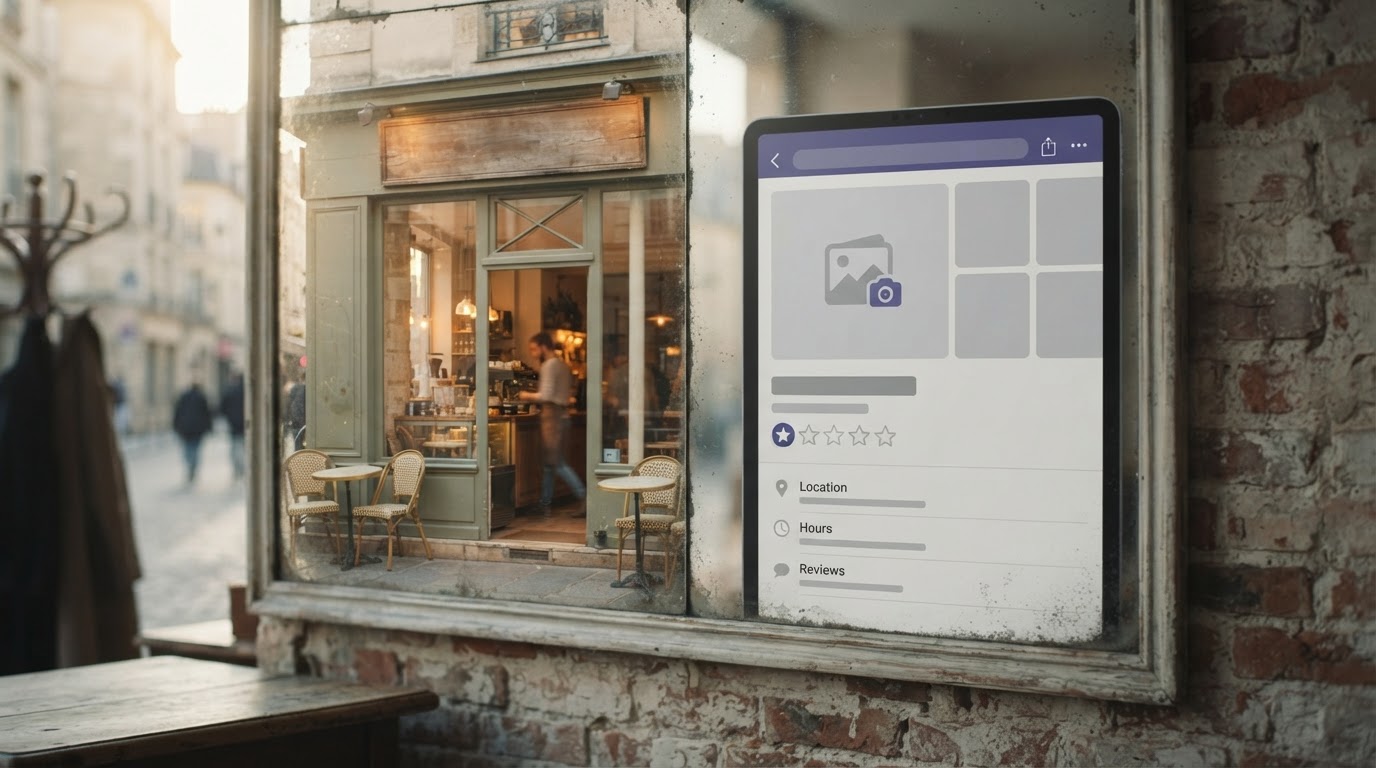
A local presence diagnosis isn't a to-do list. It's a mirror held up to your business, revealing the gap between what you think you project and what customers actually see before they step through your door. This diagnosis exposes the distance between your self-image and what Google, your reviews, your competitors, and AI engines say about you. Without that clear-eyed view, you're flying blind.
Why Diagnosing Your Local Presence Isn't Optional
You can't fix what you don't measure. You can't correct what you don't see. A local business—restaurant, salon, hotel, shop—exists today in two simultaneous spaces: the physical neighbourhood and the digital square kilometre. The second increasingly determines access to the first. Ignore that digital space and you let someone else tell your story. Often, that someone is your competitor across the street.
The local presence diagnosis isn't a luxury reserved for chains or franchises. It's the founding act of any visibility strategy. It asks the question few dare to formulate: why does the customer who needs exactly what I offer walk past my door without stopping?
The answer rarely lies in the quality of your offer. It lies in your incomplete Google profile. It lies in that rating stuck at 3.8 while your neighbour displays 4.4. It lies in those dull photos taken three years ago. It lies in the silence on your social channels. It lies in your invisibility in AI engine answers. All of that, the diagnosis brings to the surface.
A serious diagnosis doesn't just list what's missing. It reveals the leaks. It shows where you're losing customers without knowing it. It identifies the levers you neglect that your competitors pull. It translates public data—your Google listing, your reviews, nearby establishments—into concrete decisions.
What a Complete Diagnosis Must Reveal
Here's what a rigorous diagnosis must cover. Not as an administrative checklist, but as an investigation.
Your Google Profile: The Storefront You No Longer Control
Your Google Business Profile is the first thing a potential customer sees. It's also the last thing many owners update. The diagnosis starts here: is the profile claimed? Complete? Are the hours accurate? Are the photos recent, numerous, professional? Are services and attributes filled in?
This isn't ergonomics. This is commercial survival. An incomplete profile sends a signal: this business doesn't care about its image. Or worse: it might be closed.
The diagnosis also measures the profile's performance: how many views does it receive? How many clicks to your site, your number, your directions? These numbers tell you whether you truly exist in your digital neighbourhood. They reveal whether the bridge between discovery and action is intact or broken. A profile that garners thousands of impressions but zero clicks isn't a neutral asset. It's evidence of deterrence.
Your Reviews: What Your Customers Say When You're Not There
Customer reviews aren't ratings to passively absorb. They're testimonials, confessions, instruction manuals. A rigorous diagnosis analyses these reviews in depth: which words recur? Which purchase triggers do satisfied customers mention? Which barriers do the disappointed point out?
This analysis often reveals truths the owner doesn't want to hear. "The welcome is cold." "Prices aren't displayed." "You can't book online." These repeated remarks aren't attacks: they're roadmaps.
Our customer reviews analysis automatically extracts these insights: purchase triggers, barriers to loyalty, levers for average basket size. Everything is already classified, verbatim included. The diagnosis doesn't ask "Do you have reviews?" It asks: "What do they reveal that you no longer see?"
The diagnosis must also track velocity and recency. A hundred reviews accumulated five years ago carry less weight than thirty collected in the past quarter. Freshness signals vitality. Stagnation signals abandonment.
Your Competitors: Those Who Capture Your Customers Without Your Knowledge
A diagnosis that ignores competitors is a one-eyed diagnosis. You don't operate in a vacuum. You operate within a 500-metre radius where four or five establishments compete for the same clientele. The diagnosis must identify these competitors—not the ones you imagine, but the ones Google Maps places beside you in results.
For each: what rating? How many reviews? Which services displayed? Which photos? What publication frequency? Competitive analysis isn't unhealthy obsession. It's necessary lucidity. Your competitor has understood something you haven't yet seen. The diagnosis brings it to light. It reveals which establishments dominate the local pack, which keywords they own, which customer segments they capture.
Our competitor analysis automatically detects the four closest establishments, compares their strengths and weaknesses, and delivers an attack plan: which clientele to capture, which levers to activate, which weaknesses to exploit.
Your Visibility in AI Engines and Local Searches
GEO—optimisation for generative engines—is reshaping local visibility. When a user questions ChatGPT, Perplexity, or Google with AI activated, does your establishment appear in the answer? Or is it your competitor who's cited, recommended, highlighted?
This new visibility layer doesn't replace classic local SEO. It stacks on top of it. A modern diagnosis must therefore verify your presence in these AI answers, identify the criteria that surface you—or erase you—and propose necessary adjustments. Our AI visibility check automates this verification. It tests the prompts real users type. It counts citations. It measures share of voice in the generative layer.
The GEO battleground doesn't forgive half-measures. You're either in the answer or you don't exist.
Your Online Presence: Consistency, Frequency, Embodiment
The diagnosis must also scan your other touchpoints: website, social networks, directories, local press. Are they consistent with each other? Do contact details, hours, photos match from one channel to another? Do you publish regularly, or does your last post date back six months?
Publication frequency isn't influencer vanity. It's a life signal. A business silent online seems closed, even when it's open. The diagnosis reveals these black holes. It audits the rhythm, the tone, the responsiveness. It asks whether someone is home, whether the lights are on, whether the door is unlocked.
The Diagnosis Checklist: Questions to Ask in Order
Here's the complete reading grid. Don't skim it. Fill it methodically, answer after answer. Every "no" or "I don't know" is a leak to plug.
Google Business Profile
Is the profile claimed and verified? Are name, address, phone, site, hours accurate and complete? Is the primary category precise, with relevant secondary categories? Are all pertinent services and attributes checked? Do you have at least ten recent, quality photos? Is there a cover photo and logo? Are Google posts published at least weekly? Do you respond to reviews, positive and negative, within 48 hours?
Customer Reviews
What's the average rating? How many total reviews? What volume of reviews in the past three months? Which keywords recur most often in positive reviews? Which complaints or barriers appear in negative ones? Do you have a process to solicit reviews after each visit? Are responses to reviews personalised or standardised?
Local Competition
Who are your four closest competitors on Google Maps? What's their average rating? Their review count? Which services do they display that you don't? Do they publish more often than you? Do they respond faster to reviews? What do their customer reviews say about what works for them?
AI Visibility and Local Search
Does your establishment appear when someone asks an AI engine for a local recommendation in your category? Which competitors are cited instead of you? Are your NAP details consistent across all directories and platforms? Do you rank in the local pack for your core search terms?
Online Presence and Publishing
Do you have an active website with current information? When was your last social media post? Are your contact details identical across all channels? Do you have a content calendar or publish reactively? Do you monitor brand mentions and local keywords?
Each question deserves an honest answer. Not the answer you wish were true. The answer that is true.
What the Diagnosis Unlocks
A completed diagnosis doesn't just expose problems. It sequences solutions. It separates the urgent from the important. It reveals which interventions yield immediate visibility and which build long-term authority. It transforms anxiety—"I don't know where to start"—into method.
The diagnosis becomes a document you can show a partner, an accountant, a banker. It's proof that the work ahead isn't guesswork. It's engineering. You're not decorating. You're rebuilding the bridge between your offer and the people who need it.
Our 360° Scan performs this entire diagnosis automatically. You provide your Google Maps address. Zenplan analyses your profile, your real customer reviews, your four closest competitors, and delivers the complete diagnosis already written, scored, and prioritised. No manual data entry. No spreadsheet wrangling. No interpretation paralysis. The diagnosis arrives ready to act on, with every leak identified and every fix specified.
Nothing is left to chance. Nothing is left to "we should probably look into that." The mirror is held up. What you do with the reflection is your decision. But at least you see it.
Why Most Businesses Skip the Diagnosis and Pay the Price
Most local business owners skip the diagnosis because it feels like procrastination. They want action, not analysis. They want the solution, not the problem statement. This impatience is understandable. It's also expensive.
Without diagnosis, you fix the wrong things. You invest in a new website when the real issue is your Google hours being listed as "permanently closed." You run a promotion when the real problem is that no one knows you exist. You hire a social media manager when the real bottleneck is twelve unanswered one-star reviews. Diagnosis prevents that waste. It ensures every euro, every hour spent moves the needle that matters.
The other reason businesses skip diagnosis: they fear what it will reveal. Better not to know than to confront the gap between intention and reality. But that gap doesn't close by being ignored. It widens. The competitor who does diagnose, who does confront, who does act—that competitor captures the clientele that should have been yours.
You Don't Have to Do This Alone
The local presence diagnosis used to require either an agency—€500 to €2,000 a month, six-month commitment—or manual detective work across a dozen platforms, spreadsheets, competitor profiles, review archives. Most owners chose neither. They flew blind.
Zenplan built the diagnosis so you don't have to choose between expensive and impossible. You enter your business address, and the full diagnostic arrives in five minutes: visibility score out of 100, customer voice analysis, competitor comparison, AI presence check, prioritised action plan. All written, all specific to your reality, all ready to use. €39 once to unlock everything, or bundled plans for multiple locations. No subscription. No commitment. No guesswork.
The diagnosis isn't the end. It's the beginning. But it's the beginning that determines whether everything that follows actually works.
FAQ
What is a local presence diagnosis?
A local presence diagnosis is a comprehensive audit of how your business appears across the digital touchpoints that drive foot traffic: your Google Business Profile, customer reviews, competitor positioning, AI search visibility, and online consistency. It reveals the gap between what you think you project and what potential customers actually see, so you can fix the leaks that lose you business without your knowledge.
How often should I run a local presence diagnosis?
Run a full diagnosis every quarter, or immediately after any significant change: a new competitor opening nearby, a ratings drop, a change in services, or a local market shift. The digital landscape changes faster than the physical one. What was true three months ago may no longer hold.
Can I do a local presence diagnosis myself, or do I need an agency?
You can do it yourself if you're willing to manually gather data from Google Business Profile insights, scrape competitor profiles, analyse review patterns, and audit directory listings. Most owners don't have the time or tools. An agency can do it for €500–€2,000 a month with a six-month commitment. Or you can use Zenplan's automated 360° Scan, which delivers the complete diagnosis in five minutes for €39 once, with no subscription or expertise required.
What's the difference between a diagnosis and an action plan?
A diagnosis tells you what's wrong and why. An action plan tells you what to do and in what order. A complete local presence diagnostic includes both: it surfaces the problems and prioritises the fixes by impact and effort. Zenplan's action plan does exactly that—every recommendation from the diagnosis is ranked, dated, and ready to execute.
Why do most local businesses never diagnose their presence?
Because diagnosis feels like delay when they want action, and because they fear confronting the gap between their self-image and their market reality. But skipping diagnosis means fixing the wrong problems with the wrong solutions. The businesses that do diagnose are the ones that stop losing customers to competitors who simply show up better in the digital square kilometre that precedes every physical visit.
Your Scan 360°, ready to use
Zenplan analyses your Google listing, your reviews and your competitors, then delivers a complete plan.
Generate my plan